Wider discussionPublic posts · individual views

The scholarly corner: art history and flag history

Some replies turned to sources. @SaharMaranlou posted a miniature and noted that this "Chinese-looking" youth is actually Iranian, by Mohammad Yusuf, c. 1640, a reminder that Persianate art drew on East Asian conventions. @AchmadA44671276 pointed out that the crescent-and-star flag was originally the Ottoman flag (~4K). Asked about the flag, the @grok account replied that today's design derives from the 1844 Ottoman flag, was kept by the Republic and standardised by law in 1936, and that any resemblance to the meme is coincidence (as stated by Grok; not independently checked here).
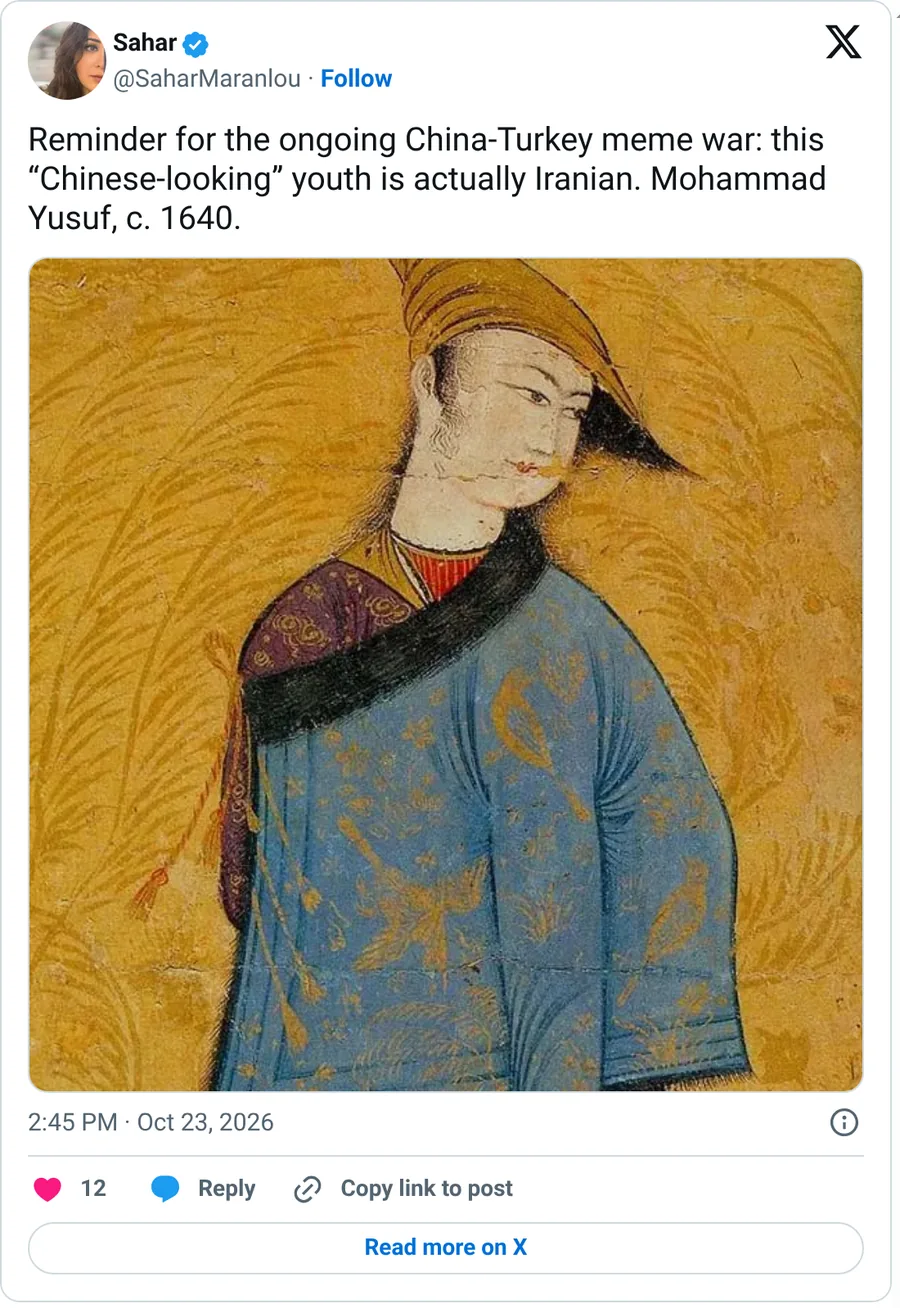
Screenshot of a post by @SaharMaranlou on X — The scholarly corner: art history and flag history
Screenshot: @SaharMaranlou · Open original post ↗

Archive record

Captured
24 Oct 2026
Likes at capture
17
Replies
0

Source post publicly visible at capture. Posted 2026-10-23 14:45 (UTC+3). Metrics are snapshots taken on the capture date, not live counts.

Sources

Authors and country

Country is the archive’s own reading of public profile and language signals unless it says otherwise; “inferred” entries can be wrong. It describes an account, not a nation.

See this entry in the timeline Reader poll: who won the meme war? Today

Read this entry in other languages

Machine-assisted translations; check the original posts for exact wording.

简体中文

学术角:艺术史与国旗史

也有回复开始引经据典。@SaharMaranlou 贴出一幅细密画,指出这位“长得像中国人”的少年其实是伊朗人,出自约 1640 年 Mohammad Yusuf 之手,说明波斯风格艺术借用了东亚画法。@AchmadA44671276 指出星月旗最初是奥斯曼帝国的旗帜(约 4000 浏览)。@grok 账号在被问及时回复,现行设计源于 1844 年的奥斯曼旗,共和国沿用并于 1936 年以法律定型,与梗图的相似纯属巧合(此为 Grok 的说法,本站未独立核实)。

繁體中文

學術角:藝術史與國旗史

也有回覆開始引經據典。@SaharMaranlou 貼出一幅細密畫,指出這位“長得像中國人”的少年其實是伊朗人,出自約 1640 年 Mohammad Yusuf 之手,說明波斯風格藝術借用了東亞畫法。@AchmadA44671276 指出星月旗最初是奧斯曼帝國的旗幟(約 4000 瀏覽)。@grok 賬號在被問及時回覆,現行設計源於 1844 年的奧斯曼旗,共和國沿用並於 1936 年以法律定型,與梗圖的相似純屬巧合(此為 Grok 的說法,本站未獨立核實)。

Türkçe

Bilimsel köşe: sanat tarihi ve bayrak tarihi

Bazı yanıtlar kaynaklara yöneldi. @SaharMaranlou bir minyatür paylaşıp bu "Çinli görünümlü" gencin aslında İranlı olduğunu, yaklaşık 1640'ta Muhammed Yusuf tarafından yapıldığını belirtti. @AchmadA44671276 ay-yıldızlı bayrağın aslen Osmanlı bayrağı olduğunu hatırlattı (~4 bin). @grok hesabı, bugünkü tasarımın 1844 Osmanlı bayrağından geldiğini, Cumhuriyet'in koruduğunu ve 1936'da kanunla standartlaştırıldığını, benzerliğin tesadüf olduğunu yazdı (Grok'un ifadesi; burada bağımsız doğrulanmadı).

日本語

学術コーナー:美術史と国旗史

出典に当たる返信も。@SaharMaranlou は細密画を示し、この「中国人風」の若者は実はイラン人で、1640年頃モハンマド・ユースフ作だと指摘。@AchmadA44671276 は星と三日月の旗はもともとオスマン帝国の旗だと指摘(約4000表示)。@grok アカウントは、現行デザインは1844年のオスマン旗に由来し、共和国が継承して1936年に法で標準化、ミームとの類似は偶然だと回答(Grokの説明であり当サイトは独自検証していない)。

한국어

학술 코너: 미술사와 국기사

출처를 짚는 답글도 있었다. @SaharMaranlou는 세밀화를 올리며 이 '중국인처럼 보이는' 소년은 사실 이란인이며 1640년경 모함마드 유수프의 작품이라고 했다. @AchmadA44671276은 초승달과 별 깃발이 원래 오스만 깃발이었다고 지적했다(약 4,000). @grok 계정은 현행 디자인이 1844년 오스만 깃발에서 왔고 공화국이 계승해 1936년 법으로 표준화했으며 밈과의 유사성은 우연이라고 답했다(Grok의 설명, 본 사이트 독자 검증 안 됨).

Русский

Научный уголок: история искусства и флага

Часть ответов обратилась к источникам. @SaharMaranlou выложил(а) миниатюру и отметил(а), что этот «китайского вида» юноша на самом деле иранец, работа Мохаммада Юсуфа ок. 1640 г. @AchmadA44671276 напомнил, что флаг с полумесяцем и звездой изначально был османским (~4 тыс.). Аккаунт @grok ответил, что нынешний дизайн восходит к османскому флагу 1844 года, сохранён Республикой и закреплён законом в 1936 году, а сходство с мемом случайно (по словам Grok; здесь не проверено).

العربية

الركن العلمي: تاريخ الفن وتاريخ العلم

اتجهت بعض الردود إلى المصادر. نشر الحساب @SaharMaranlou منمنمة وأشار إلى أن هذا الشاب «ذا الملامح الصينية» إيراني في الحقيقة، من عمل محمد يوسف نحو 1640. وأوضح @AchmadA44671276 أن علم الهلال والنجمة كان في الأصل علم الدولة العثمانية (~4 آلاف). وردّ حساب @grok بأن التصميم الحالي مستمد من العلم العثماني لعام 1844 واحتفظت به الجمهورية وقُنِّن عام 1936، وأن أي تشابه مع الميم مصادفة (بحسب Grok؛ لم يُتحقق منه هنا).

Español

El rincón académico: historia del arte y de la bandera

Algunas respuestas recurrieron a fuentes. @SaharMaranlou publicó una miniatura y señaló que este joven de «aspecto chino» es en realidad iraní, obra de Mohammad Yusuf, h. 1640. @AchmadA44671276 recordó que la bandera de media luna y estrella era originalmente la otomana (~4 mil). La cuenta @grok respondió que el diseño actual deriva de la bandera otomana de 1844, la República lo conservó y lo normalizó por ley en 1936, y que el parecido con el meme es casual (según Grok; no verificado aquí).

Français

Le coin savant : histoire de l'art et du drapeau

Certaines réponses ont cité des sources. @SaharMaranlou a publié une miniature en notant que ce jeune « à l'air chinois » est en fait iranien, œuvre de Mohammad Yusuf vers 1640. @AchmadA44671276 a rappelé que le drapeau au croissant et à l'étoile était à l'origine celui de l'Empire ottoman (~4 k). Le compte @grok a répondu que le dessin actuel dérive du drapeau ottoman de 1844, conservé par la République et normalisé par la loi en 1936, et que toute ressemblance avec le mème est fortuite (selon Grok ; non vérifié ici).

Deutsch

Die Gelehrtenecke: Kunst- und Flaggengeschichte

Einige Antworten griffen zu Quellen. @SaharMaranlou postete eine Miniatur und merkte an, dieser „chinesisch aussehende“ Jüngling sei eigentlich Iraner, gemalt von Mohammad Yusuf um 1640. @AchmadA44671276 erinnerte daran, dass die Flagge mit Halbmond und Stern ursprünglich die osmanische war (~4 Tsd.). Der Account @grok antwortete, das heutige Design gehe auf die osmanische Flagge von 1844 zurück, sei von der Republik übernommen und 1936 gesetzlich normiert worden; Ähnlichkeit mit dem Meme sei Zufall (laut Grok; hier nicht geprüft).

About this archive

PATFLAG is a neutral, continuously updated archive of the China–Türkiye online dispute around the Patrick Star flag image: public posts, screenshots and sources, in 11 languages. Colors mark the context of individual public posts, not the position of an entire country. Insulting language in original posts is kept verbatim so the record stays complete; inclusion is not an endorsement of any account. Full timeline