"Superb insult skills": a Beijing account's history lesson for Turks
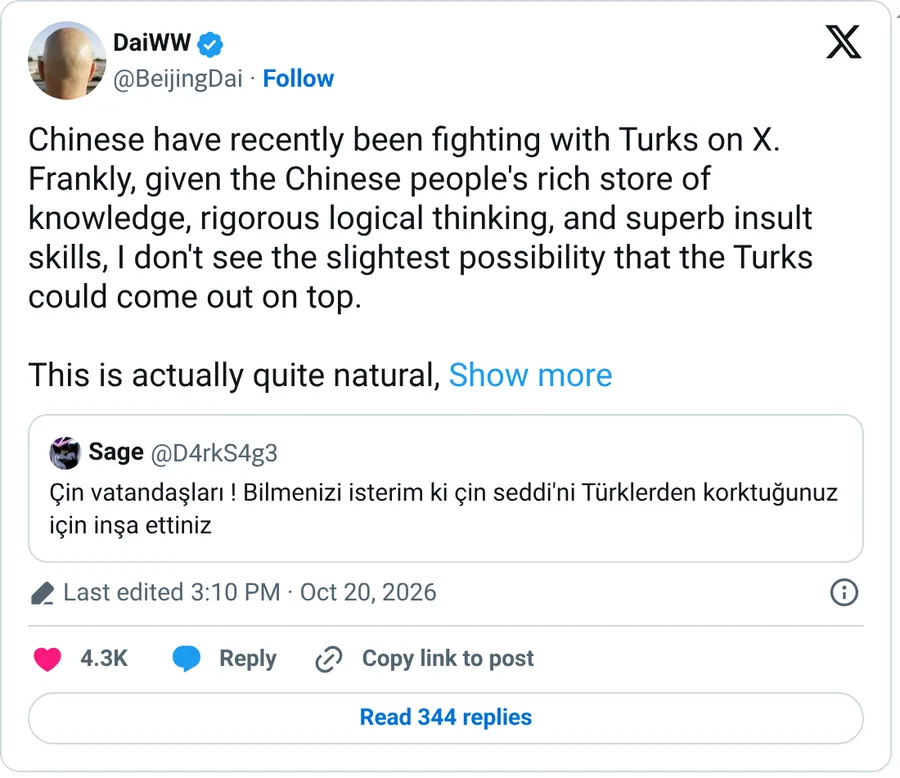
English-language account @BeijingDai (display name "DaiWW", ~63K followers, profile location Beijing) quoted @D4rkS4g3's viral post claiming the Great Wall was built out of fear of Turks, and posted on 20 Oct at 15:10 (UTC+3): "Chinese have recently been fighting with Turks on X. Frankly, given the Chinese people's rich store of knowledge, rigorous logical thinking, and superb insult skills, I don't see the slightest possibility that the Turks could come out on top." (~362K views, 4,307 likes, 344 replies). The long post then listed what it presented as a record of Turkish defeats by China: the Xiongnu driven into Central Asia by the Han in the 2nd century BC, the Turkic Khaganate destroyed by the Tang in the 6th–7th centuries, Yaqub Beg, who had recognised Ottoman suzerainty, crushed by the Qing in Xinjiang, and Turkish troops killed or captured in large numbers by the Chinese in the Korean War. It ended by contrasting the "Sick Man of West Asia" with the "Sick Man of East Asia": the Ottoman Empire fell apart, while the Chinese "rebuilt themselves into the most powerful country in the world". The framing is the poster's; the Xiongnu–Turk link in particular is disputed among historians. The top reply, in Turkish, hit back.
Country is the archive’s own reading of public profile and language signals unless it says otherwise; “inferred” entries can be wrong. It describes an account, not a nation.
Machine-assisted translations; check the original posts for exact wording.
简体中文
“高超的骂人技巧”:北京账号给土耳其人上的历史课
英文账号 @BeijingDai(显示名“DaiWW”,约 6.3 万粉丝,所在地显示为北京)引用 @D4rkS4g3 那条称长城是因害怕突厥人而修建的爆红帖子,10 月 20 日 15:10(UTC+3)发帖:“Chinese have recently been fighting with Turks on X. Frankly, given the Chinese people's rich store of knowledge, rigorous logical thinking, and superb insult skills, I don't see the slightest possibility that the Turks could come out on top.”(“中国人最近在 X 上和土耳其人吵架。坦白说,凭中国人丰富的知识储备、严密的逻辑思维和高超的骂人技巧,我看不出土耳其人有一丝一毫占上风的可能。”)(约 36.2 万浏览、4,307 赞、344 回复)。长文随后列举了它所说的突厥人屡败于中国的历史:公元前 2 世纪匈奴被汉朝逐往中亚,6 世纪突厥汗国被唐朝所灭,19 世纪奉奥斯曼为宗主的阿古柏被清朝消灭,20 世纪参加朝鲜战争的土耳其军队被中国军队大量杀伤和俘虏;最后以“西亚病夫”和“东亚病夫”作对比:奥斯曼帝国已经解体,而中国则重建为世界上最强大的国家。以上是发帖人的叙述,其中匈奴与突厥的承袭关系在史学界仍有争议。最高回复是一条土耳其语回复,反唇相讥。
英文賬號 @BeijingDai(顯示名“DaiWW”,約 6.3 萬粉絲,所在地顯示為北京)引用 @D4rkS4g3 那條稱長城是因害怕突厥人而修建的爆紅帖子,10 月 20 日 15:10(UTC+3)發帖:“Chinese have recently been fighting with Turks on X. Frankly, given the Chinese people's rich store of knowledge, rigorous logical thinking, and superb insult skills, I don't see the slightest possibility that the Turks could come out on top.”(“中國人最近在 X 上和土耳其人吵架。坦白說,憑中國人豐富的知識儲備、嚴密的邏輯思維和高超的罵人技巧,我看不出土耳其人有一絲一毫佔上風的可能。”)(約 36.2 萬瀏覽、4,307 贊、344 回覆)。長文隨後列舉了它所說的突厥人屢敗於中國的歷史:公元前 2 世紀匈奴被漢朝逐往中亞,6 世紀突厥汗國被唐朝所滅,19 世紀奉奧斯曼為宗主的阿古柏被清朝消滅,20 世紀參加朝鮮戰爭的土耳其軍隊被中國軍隊大量殺傷和俘虜;最後以“西亞病夫”和“東亞病夫”作對比:奧斯曼帝國已經解體,而中國則重建為世界上最強大的國家。以上是發帖人的敘述,其中匈奴與突厥的承襲關係在史學界仍有爭議。最高回覆是一條土耳其語回覆,反脣相譏。
“Üstün hakaret becerileri”: Pekinli bir hesaptan Türklere tarih dersi
İngilizce hesap @BeijingDai (görünen ad “DaiWW”, ~63 bin takipçi, profil konumu Pekin), Çin Seddi’nin Türklerden korkulduğu için yapıldığını söyleyen @D4rkS4g3’ün viral paylaşımını alıntılayıp 20 Ekim saat 15:10’da (UTC+3) şunu yazdı: “Chinese have recently been fighting with Turks on X. Frankly, given the Chinese people's rich store of knowledge, rigorous logical thinking, and superb insult skills, I don't see the slightest possibility that the Turks could come out on top.” (“Çinliler son zamanlarda X’te Türklerle kavga ediyor. Açıkçası Çin halkının zengin bilgi birikimi, titiz mantıksal düşüncesi ve üstün hakaret becerileri göz önüne alındığında, Türklerin galip gelme ihtimalini en ufak ölçüde görmüyorum.”) (~362 bin görüntülenme, 4.307 beğeni, 344 yanıt). Uzun paylaşım ardından Türklerin Çin karşısındaki yenilgileri olarak sunduğu bir liste sıraladı: MÖ 2. yüzyılda Han hanedanının Orta Asya’ya sürdüğü Hunlar (Xiongnu), 6.–7. yüzyılda Tang’ın yıktığı Göktürk Kağanlığı, Osmanlı hükümranlığını tanıyan Yakup Bey’in Sincan’da Qing tarafından ezilmesi ve Kore Savaşı’nda Çinlilerce çok sayıda öldürülen ya da esir alınan Türk askerleri. Paylaşım, “Batı Asya’nın hasta adamı” ile “Doğu Asya’nın hasta adamı”nı karşılaştırarak bitti: Osmanlı dağıldı, Çin ise kendini dünyanın en güçlü ülkesi olarak yeniden inşa etti. Çerçeve paylaşım sahibine ait; özellikle Hun–Türk bağı tarihçiler arasında tartışmalı. En üstteki Türkçe yanıt sert karşılık verdi.
Popüler yanıt: Çinliler hiç bir bok yapamamış. Binlerce yıldır aynı yerdesiniz korkunuzdan japonyaya kafa tutamıyorsunuz. Biz kaç kıtaya hükmettik. Belki koruyamadık ama kimseninde sömürgesi olmadık. Siz japnların oldunuz.
日本語
「卓越した罵倒スキル」:北京のアカウントがトルコ人に歴史の講義
英語アカウント @BeijingDai(表示名「DaiWW」、フォロワー約6.3万人、プロフィールの所在地は北京)は、万里の長城はトルコ人を恐れて築かれたとする @D4rkS4g3 のバズった投稿を引用し、10月20日15:10(UTC+3)に投稿した:「Chinese have recently been fighting with Turks on X. Frankly, given the Chinese people's rich store of knowledge, rigorous logical thinking, and superb insult skills, I don't see the slightest possibility that the Turks could come out on top.」(「中国人は最近Xでトルコ人とけんかしている。率直に言って、中国人の豊富な知識、厳密な論理的思考、そして卓越した罵倒スキルを考えれば、トルコ人が優位に立つ可能性は微塵もないと思う。」)(約36.2万閲覧、4,307いいね、344返信)。長文はさらに、トルコ人が中国に負け続けた歴史だとして次の例を挙げた:紀元前2世紀に漢に中央アジアへ追われた匈奴、6〜7世紀に唐に滅ぼされた突厥、オスマン帝国を宗主と仰ぎながら新疆で清に滅ぼされたヤクブ・ベク、朝鮮戦争で中国軍に多数が殺害・捕虜にされたトルコ軍。最後は「西アジアの病人」と「東アジアの病人」を比べ、オスマン帝国は解体したが、中国人は世界最強の国として自らを再建したと結んだ。この構図は投稿者によるもので、特に匈奴と突厥のつながりは歴史家の間でも議論がある。最上位の返信はトルコ語で、言い返すものだった。
영어 계정 @BeijingDai(표시 이름 「DaiWW」, 팔로워 약 6만 3천 명, 프로필 위치 베이징)는 만리장성이 튀르크인이 두려워 지어졌다는 @D4rkS4g3의 화제 게시물을 인용해 10월 20일 15:10(UTC+3)에 게시했다: 「Chinese have recently been fighting with Turks on X. Frankly, given the Chinese people's rich store of knowledge, rigorous logical thinking, and superb insult skills, I don't see the slightest possibility that the Turks could come out on top.」(「중국인들이 요즘 X에서 튀르키예인들과 싸우고 있다. 솔직히 중국인의 풍부한 지식, 엄밀한 논리적 사고, 탁월한 욕 실력을 생각하면 튀르키예인이 우위를 점할 가능성은 조금도 없어 보인다.」)(약 36.2만 조회, 좋아요 4,307개, 답글 344개). 긴 글은 이어 튀르크인이 중국에 패배해 온 역사라며 다음을 나열했다: 기원전 2세기 한나라에 의해 중앙아시아로 쫓겨난 흉노, 6~7세기 당나라에 멸망한 돌궐, 오스만의 종주권을 인정했다가 신장에서 청나라에 격파된 야쿱 벡, 한국전쟁에서 중국군에게 대거 사망하거나 포로가 된 튀르키예군. 마지막으로 「서아시아의 병자」와 「동아시아의 병자」를 비교하며, 오스만 제국은 해체됐지만 중국인은 세계 최강국으로 스스로를 재건했다고 맺었다. 이 구도는 게시자의 것이며, 특히 흉노와 튀르크의 연관성은 역사학계에서도 논란이 있다. 가장 인기 있는 답글은 튀르키예어로 반격하는 내용이었다.
인기 답글: 중국인들은 개뿔 하나 해낸 게 없다. 수천 년째 같은 곳에 있으면서 무서워서 일본한테 대들지도 못한다. 우리는 몇 개 대륙을 지배했다. 지키지 못했을지는 몰라도 누구의 식민지도 된 적 없다. 너희는 일본인들의 식민지가 됐지.
Русский
«Непревзойдённое умение оскорблять»: урок истории для турок от пекинского аккаунта
Англоязычный аккаунт @BeijingDai (отображаемое имя «DaiWW», ~63 тыс. подписчиков, в профиле указан Пекин) процитировал вирусный пост @D4rkS4g3 о том, что Великую стену построили из страха перед турками, и опубликовал 20 октября в 15:10 (UTC+3): «Chinese have recently been fighting with Turks on X. Frankly, given the Chinese people's rich store of knowledge, rigorous logical thinking, and superb insult skills, I don't see the slightest possibility that the Turks could come out on top.» («Китайцы в последнее время ругаются с турками в X. Честно говоря, учитывая богатый запас знаний, строгое логическое мышление и непревзойдённое умение оскорблять у китайского народа, я не вижу ни малейшего шанса, что турки возьмут верх.») (~362 тыс. просмотров, 4307 лайков, 344 ответа). Далее длинный пост перечислял то, что он представил как историю поражений турок от Китая: сюнну, вытесненные династией Хань в Центральную Азию во II веке до н. э.; Тюркский каганат, уничтоженный Тан в VI–VII веках; Якуб-бек, признававший сюзеренитет Османской империи и разгромленный Цин в Синьцзяне; турецкие солдаты, во множестве убитые или взятые в плен китайцами в Корейской войне. В конце пост сравнил «больного человека Западной Азии» и «больного человека Восточной Азии»: Османская империя распалась, а китайцы возродились и стали самой могущественной страной мира. Это трактовка автора; в частности, связь сюнну и тюрок среди историков спорна. Самый популярный ответ, на турецком, был ответным выпадом.
Популярный ответ: Китайцы ни хрена не сделали. Вы тысячи лет сидите на одном месте и от страха не смеете дать отпор Японии. А мы правили сколькими континентами. Может, не удержали, но и ничьей колонией не были. А вы стали колонией японцев.
العربية
"مهارات شتم فائقة": درس تاريخ من حساب في بكين للأتراك
اقتبس الحساب الناطق بالإنجليزية @BeijingDai (الاسم الظاهر "DaiWW"، نحو 63 ألف متابع، موقعه في الملف الشخصي بكين) منشور @D4rkS4g3 الواسع الانتشار الذي زعم أن سور الصين العظيم بُني خوفًا من الأتراك، ونشر في 20 أكتوبر الساعة 15:10 (UTC+3): "Chinese have recently been fighting with Turks on X. Frankly, given the Chinese people's rich store of knowledge, rigorous logical thinking, and superb insult skills, I don't see the slightest possibility that the Turks could come out on top." («يتشاجر الصينيون مؤخرًا مع الأتراك على X. بصراحة، بالنظر إلى المخزون المعرفي الغني لدى الشعب الصيني وتفكيره المنطقي الصارم ومهاراته الفائقة في الشتم، لا أرى أدنى احتمال لأن يتفوق الأتراك.») (نحو 362 ألف مشاهدة و4307 إعجابًا و344 ردًا). ثم عدّد المنشور الطويل ما قدّمه على أنه سجل هزائم الأتراك أمام الصين: الهون (شيونغنو) الذين طردتهم سلالة هان إلى آسيا الوسطى في القرن الثاني قبل الميلاد، والخاقانية التركية التي دمرتها سلالة تانغ في القرنين السادس والسابع، ويعقوب بك الذي اعترف بسيادة العثمانيين وسحقته سلالة تشينغ في شينجيانغ، والجنود الأتراك الذين قُتل أو أُسر كثير منهم على يد الصينيين في الحرب الكورية. وختم بالمقارنة بين «رجل غرب آسيا المريض» و«رجل شرق آسيا المريض»: تفككت الدولة العثمانية، بينما أعاد الصينيون بناء أنفسهم ليصبحوا أقوى دولة في العالم. هذا الإطار هو رواية صاحب المنشور، والصلة بين الهون والأتراك تحديدًا محل خلاف بين المؤرخين. وجاء أبرز رد بالتركية ليرد الهجوم.
الرد الشائع: الصينيون لم يفعلوا أي شيء يُذكر. أنتم في المكان نفسه منذ آلاف السنين، ومن خوفكم لا تجرؤون على مواجهة اليابان. أما نحن فحكمنا كم قارة. ربما لم نحافظ عليها، لكننا لم نكن مستعمرة لأحد. أما أنتم فصرتم مستعمرة لليابانيين.
Español
«Habilidades insuperables para insultar»: una lección de historia para los turcos desde una cuenta de Pekín
La cuenta en inglés @BeijingDai (nombre visible «DaiWW», ~63 000 seguidores, ubicación de perfil Pekín) citó la publicación viral de @D4rkS4g3 que afirmaba que la Gran Muralla se construyó por miedo a los turcos y publicó el 20 de oct. a las 15:10 (UTC+3): «Chinese have recently been fighting with Turks on X. Frankly, given the Chinese people's rich store of knowledge, rigorous logical thinking, and superb insult skills, I don't see the slightest possibility that the Turks could come out on top.» («Los chinos llevan un tiempo peleándose con los turcos en X. Francamente, dado el rico acervo de conocimientos, el riguroso pensamiento lógico y las insuperables habilidades para insultar del pueblo chino, no veo la menor posibilidad de que los turcos salgan ganando.») (~362 mil visualizaciones, 4307 Me gusta, 344 respuestas). El largo texto enumeraba después lo que presentaba como un historial de derrotas turcas ante China: los xiongnu, expulsados hacia Asia Central por los Han en el siglo II a. C.; el kanato túrquico, destruido por los Tang en los siglos VI y VII; Yaqub Beg, que había reconocido la soberanía otomana, aplastado por los Qing en Xinjiang; y soldados turcos muertos o capturados en gran número por los chinos en la guerra de Corea. Terminaba comparando al «enfermo de Asia occidental» con el «enfermo de Asia oriental»: el Imperio otomano se desintegró, mientras que los chinos se reconstruyeron hasta convertirse en el país más poderoso del mundo. El enfoque es del autor; en particular, el vínculo entre xiongnu y turcos es discutido entre los historiadores. La respuesta principal, en turco, contraatacó.
Respuesta popular: Los chinos nunca consiguieron hacer una mierda. Lleváis miles de años en el mismo sitio y del miedo no os atrevéis a plantarle cara a Japón. Nosotros dominamos cuántos continentes. Quizá no supimos conservarlos, pero tampoco fuimos colonia de nadie. Vosotros fuisteis la de los japoneses.
Français
« Des talents d’insulte hors pair » : la leçon d’histoire d’un compte pékinois aux Turcs
Le compte anglophone @BeijingDai (nom affiché « DaiWW », ~63 000 abonnés, localisation de profil Pékin) a cité le post viral de @D4rkS4g3 affirmant que la Grande Muraille avait été construite par peur des Turcs, et a publié le 20 oct. à 15 h 10 (UTC+3) : « Chinese have recently been fighting with Turks on X. Frankly, given the Chinese people's rich store of knowledge, rigorous logical thinking, and superb insult skills, I don't see the slightest possibility that the Turks could come out on top. » (« Les Chinois se disputent ces derniers temps avec les Turcs sur X. Franchement, vu la riche culture, la rigueur logique et les talents d’insulte hors pair du peuple chinois, je ne vois pas la moindre chance que les Turcs prennent le dessus. ») (~362 000 vues, 4 307 J’aime, 344 réponses). Le long post énumérait ensuite ce qu’il présentait comme un palmarès des défaites turques face à la Chine : les Xiongnu chassés vers l’Asie centrale par les Han au IIe siècle av. J.-C., le khaganat turc détruit par les Tang aux VIe et VIIe siècles, Yakub Beg, qui avait reconnu la suzeraineté ottomane, écrasé par les Qing au Xinjiang, et des soldats turcs tués ou capturés en grand nombre par les Chinois pendant la guerre de Corée. Il concluait en comparant « l’homme malade de l’Asie occidentale » et « l’homme malade de l’Asie orientale » : l’Empire ottoman s’est disloqué, tandis que les Chinois se sont reconstruits pour devenir le pays le plus puissant du monde. Ce cadrage est celui de l’auteur ; le lien Xiongnu–Turcs en particulier est débattu chez les historiens. La réponse la plus populaire, en turc, a contre-attaqué.
Réponse populaire: Les Chinois n’ont jamais rien foutu. Vous êtes au même endroit depuis des milliers d’années et, de peur, vous n’osez pas tenir tête au Japon. Nous avons régné sur combien de continents. On ne les a peut-être pas gardés, mais nous n’avons jamais été la colonie de personne. Vous, vous avez été celle des Japonais.
Deutsch
„Überragende Beleidigungskünste“: Geschichtsstunde eines Pekinger Accounts für Türken
Der englischsprachige Account @BeijingDai (Anzeigename „DaiWW“, ~63.000 Follower, Profilort Peking) zitierte den viralen Post von @D4rkS4g3, die Große Mauer sei aus Angst vor den Türken gebaut worden, und postete am 20. Okt. um 15:10 Uhr (UTC+3): „Chinese have recently been fighting with Turks on X. Frankly, given the Chinese people's rich store of knowledge, rigorous logical thinking, and superb insult skills, I don't see the slightest possibility that the Turks could come out on top.“ („Chinesen streiten sich in letzter Zeit auf X mit Türken. Offen gesagt sehe ich angesichts des reichen Wissensschatzes, des strengen logischen Denkens und der überragenden Beleidigungskünste der Chinesen nicht die geringste Chance, dass die Türken die Oberhand gewinnen.“) (~362.000 Aufrufe, 4.307 Likes, 344 Antworten). Der lange Post listete dann auf, was er als Bilanz türkischer Niederlagen gegen China darstellte: die Xiongnu, im 2. Jahrhundert v. Chr. von der Han-Dynastie nach Zentralasien vertrieben; das Türkische Khaganat, im 6.–7. Jahrhundert von der Tang zerstört; Yakub Beg, der die osmanische Oberhoheit anerkannt hatte, von den Qing in Xinjiang zerschlagen; und türkische Soldaten, die im Koreakrieg in großer Zahl von Chinesen getötet oder gefangen genommen wurden. Am Ende verglich er den „kranken Mann Westasiens“ mit dem „kranken Mann Ostasiens“: Das Osmanische Reich zerfiel, während die Chinesen sich zum mächtigsten Land der Welt wiederaufgebaut hätten. Die Deutung stammt vom Verfasser; gerade die Verbindung Xiongnu–Türken ist unter Historikern umstritten. Die Top-Antwort auf Türkisch schlug zurück.
Beliebte Antwort: Die Chinesen haben nie irgendeinen Scheiß zustande gebracht. Ihr hockt seit Jahrtausenden am selben Ort und traut euch aus Angst nicht, Japan die Stirn zu bieten. Wir haben über wie viele Kontinente geherrscht. Vielleicht konnten wir sie nicht halten, aber wir waren auch nie jemandes Kolonie. Ihr wurdet die der Japaner.
About this archive
PATFLAG is a neutral, continuously updated archive of the China–Türkiye online dispute around the Patrick Star flag image: public posts, screenshots and sources, in 11 languages. Colors mark the context of individual public posts, not the position of an entire country. Insulting language in original posts is kept verbatim so the record stays complete; inclusion is not an endorsement of any account. Full timeline